Engineering a Well-Rounded Career
Why a liberal arts degree is exactly what makes these engineers stand out in their respective disciplines

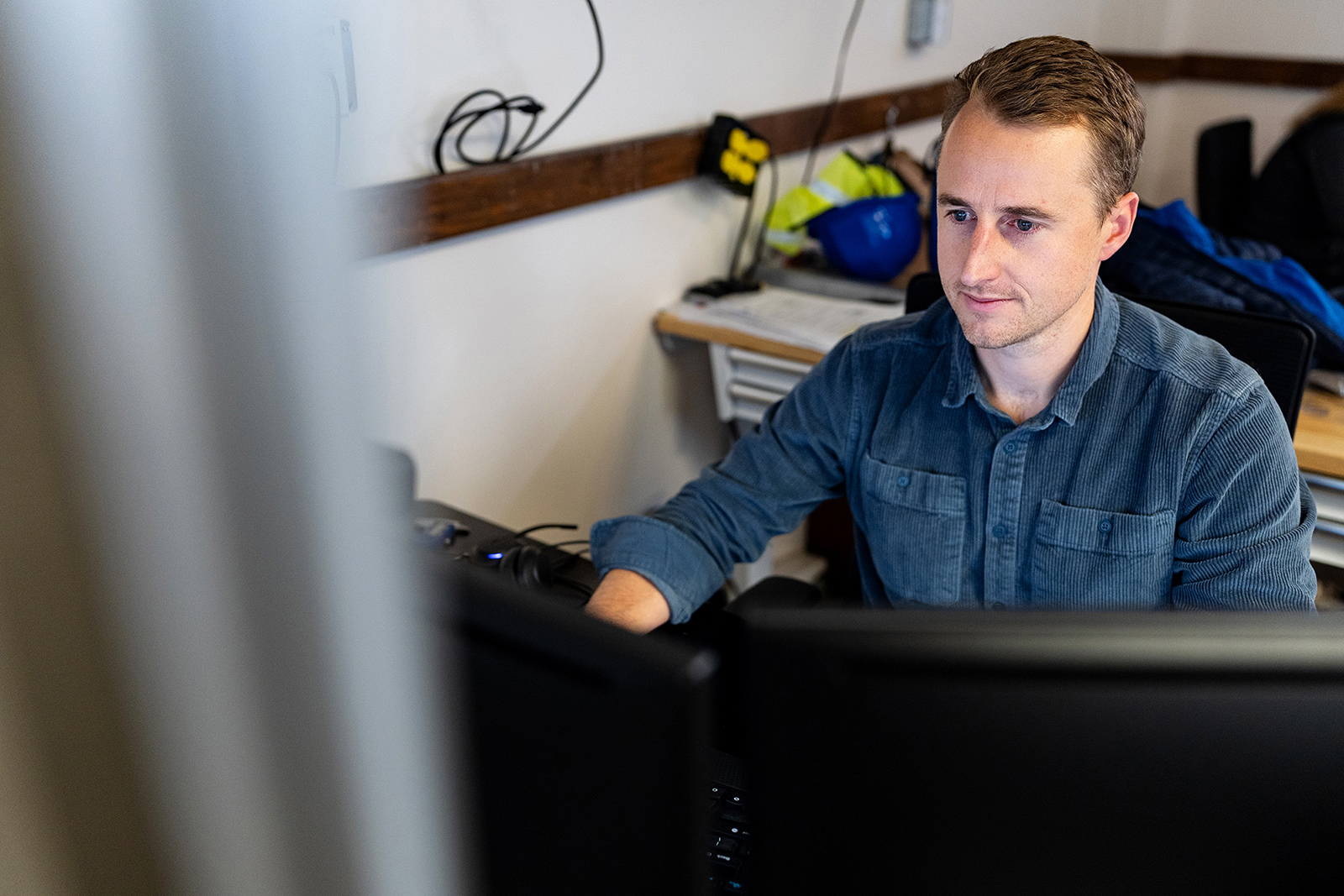
Many Colby graduates, including William Randall ’14, cite their liberal arts education as a foundation for their success as engineers. Randall is the director of product development at STARC Systems in Brunswick, Maine. (Photo by Ashley L. Conti)
By Kayla Voigt ’14
It’s easy to move about your daily life and forget the feats of engineering that get you from place to place. Consider a trip to the grocery store. You may drive a car (invented 1886) on asphalt (1870) into a metered parking spot (1938), then enter the store through automatic doors (1954) and grab a shopping cart (1984). And of course, you probably put a list on your iPhone (2007).
It took teams of engineers years of research and refinement to invent all the things we take for granted on a daily basis. Their role is firmly rooted in the problems of the real world: How can I get from A to B? How can I carry these groceries around the store? What if I could put a computer in my pocket?
“Every day is about solving a different problem,” said Will Randall ’14. “It’s easy to point to my physics and mathematics background from Colby as useful, but truly, it’s my entire liberal arts education. It plays such a big part in understanding how people think and interact. A liberal arts education broadens your horizon.”
Many Colby graduates, like Randall, cite their liberal arts education as a foundation for their success as engineers. In the future, Colby students will have an easier path to explore their interests in engineering, thanks to a science and technology initiative introducing interdisciplinary engineering programs that draw on biology, chemistry, environmental studies, and physics.
Part of a planned $500 million investment in the sciences, a new science complex will allow Colby to address current and future science, educational, and research needs and enable faculty and students to lead in new and emerging fields, including biomedical engineering, environmental engineering, materials engineering, and public health.
What’s exciting about these programs isn’t just that they’ll offer new scientific disciplines for Colby students to explore; it’s that they build upon the well-rounded education Colby students already bring to engineering problems around the world.
Engineering a fundamental human right: water
At Colby, students interested in engineering start by looking at people problems and then add technical mastery. They may be drawn to the fundamentals, such as physics or chemistry, or follow their interests, as did civil engineer Erica Lei ’20, who double-majored in environmental studies and mathematics before earning her graduate degree at Stanford University.
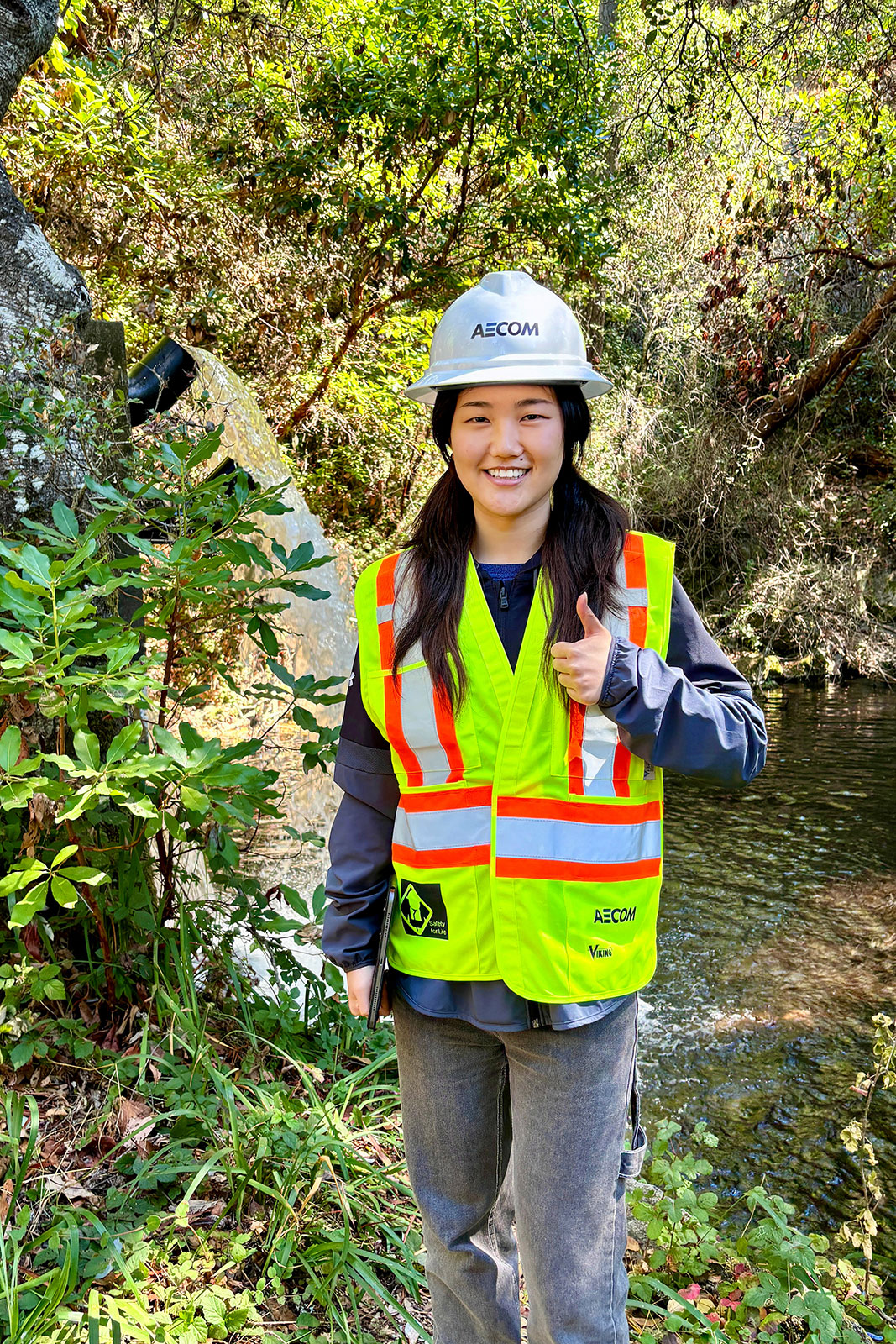
“As a water engineer, my goal is for everyone to have equal water rights,” she said. “I work on water infrastructure design and rehabilitation, which usually means designing and routing water pipelines across California.”
Building waterways, she spends just as much time working with the people her projects impact as she does doing the technical work of getting it done. “I think my Colby background makes it easier to have these kinds of deeper cultural and historical conversations about land and water to get these projects done,” said Lei. “I’m not just an engineer looking at pipes. I have to think about the bigger picture, whether that’s farms, tribal lands, or bus lanes that this water pipe will impact.”
The first known aqueducts date back to 2000 B.C. Today, Lei and her team focus not just on new pipelines but on finding ways to fix old ones—some, such as the Moccasin Penstock, are more than 100 years old. “When it comes to the engineering part, there’s so much that goes into the project, from choosing what material to use, considering soil corrosivity, the seismic conditions, the water pressure and flow, and the water quality,” said Lei.
It was during her time at Colby that she realized she could combine her mathematical skills with her focus on ecological systems to become an engineer. “I knew I didn’t want to sit in front of a computer every day,” she laughed. “After such a hands-on education at Colby, especially in ecology, where you’re going out on hikes or running experiments in all weather, I wanted to apply that to my career. I still use my GIS [geographical information system] skills all the time to visualize projects for clients.”
Said Lei, “My Colby education has been such an advantage. I may not have done specifics on the engineering work I’m doing today, but my natural science background has helped me talk outside the numbers to clients and to project stakeholders.”
Engineering the everyday: mechanical
That’s the same approach that Randall took to his Colby education, adding an anthropology minor to his physics major just because it was interesting. “Coming into Colby, I was very interested in engineering as a career path, and my physics degree allowed me to understand the very basic concepts that make up engineering,” he said. “But what’s so unique about the liberal arts in general is that you get to take so many other classes. I was taking contemporary dance and every anthropology class I could fit into my schedule.”
While in graduate school at the University of Colorado Boulder, Randall found a way to bring both sides of his education together through product design. “I wasn’t sure how I could combine the hard sciences and this love of understanding people and society until I took my first product development class,” he said. “There’s such a human-centered component around any sort of product design, because you need to understand how people think, how they interact with one another, and how they interact with products around them if you want to be successful. So there’s the mechanical engineering side of it, but it’s very much people-oriented.”

Now, he’s the director of product development at STARC Systems, which builds modular, temporary, reusable walls for occupied renovations in commercial settings such as hospitals and airports. “My job is to discover what problems we’re trying to solve for our customers, and then solve them,” said Randall, who has received four patents for his work. “It’s a lot of problem solving, and I get to use my background from Colby all the time in how I think about the customer in what we do.”
Engineering green energy: electrical
Taking a people-first approach to engineering is what excites John Tortorello ’15 about going to work each day. But let’s hope the average person won’t be handling the nuclear fusion device that Tortorello, a nuclear and radiological engineer, and his team are working on.
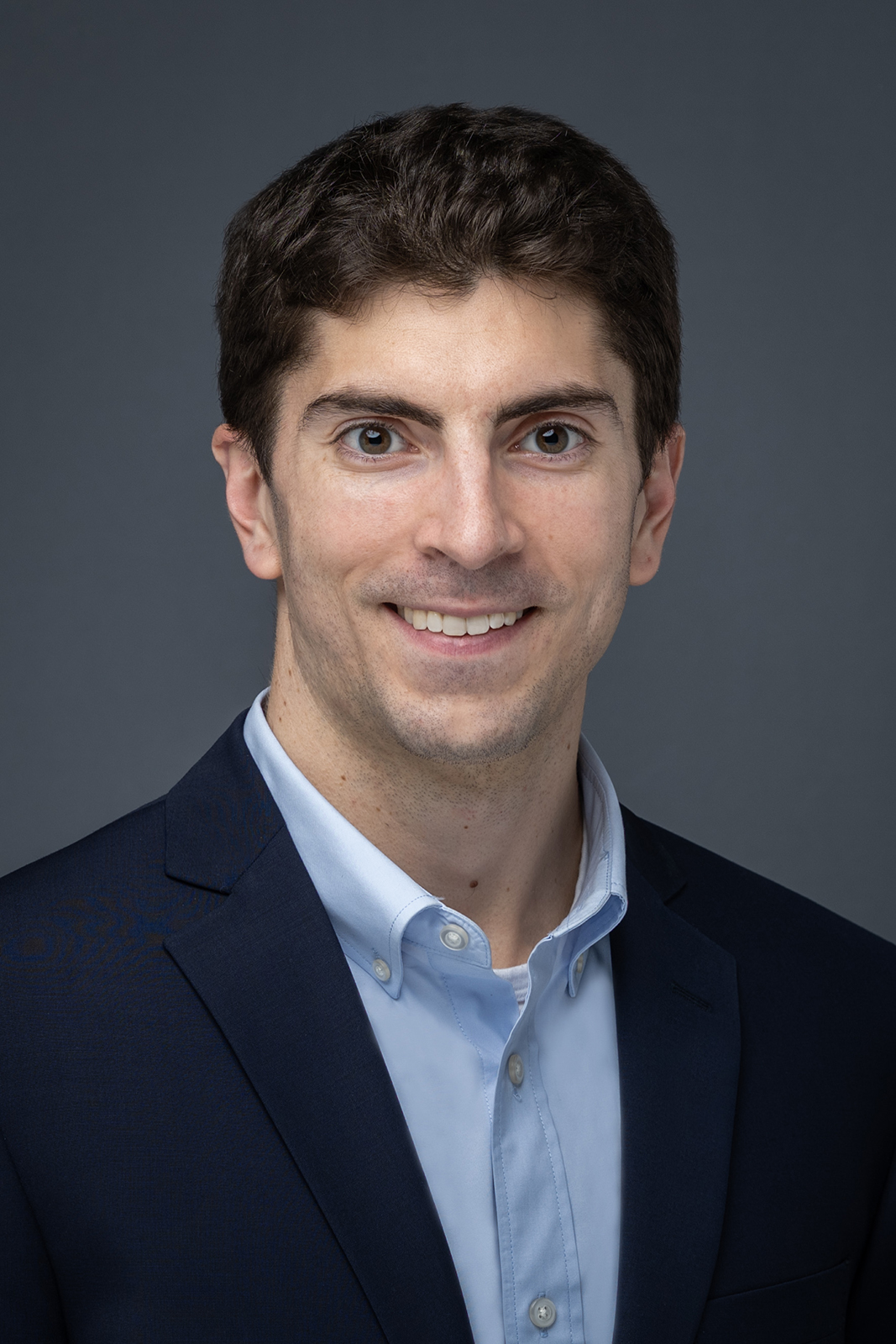
“Right now, there’s so much demand for electricity, especially driven by the rise of AI,” said Tortorello. A single ChatGPT query uses 2.9 watt-hours of electricity, about 10 times that of a standard Google search. “A lot of people have a negative association with nuclear energy, but it’s actually much cleaner than other types of fuel. Our goal is to provide more green energy to the grid,” he said.
While he loves the hands-on aspect of engineering, he originally thought he would be a teacher, double-majoring in physics and creative writing. “I knew I loved physics, but not what that meant in practice,” said Tortorello, who spent a year as a teaching fellow at a private school while applying to graduate programs. “By the time I graduated from the University of Michigan with my engineering degree, I wanted something that would do both, so I got a job as an engineering consultant, focusing on nuclear policy. It’s something that you want to make sure is super safe, and it is an industry with lots of regulation, so I would verify that a facility was up to code, for example.”
Despite a super technical, high-stakes position, Tortorello points to his Colby degree as broader skills running in the background of his workday. “My liberal arts background is an advantage in the long run because I’m not one-dimensional when I approach different problems. I have the freedom to be able to feel like if this doesn’t work out, I can learn something new and try something else.”